



Chest Freezer Buying Guide: Sizes, Running Costs & Garage Suitability
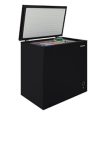
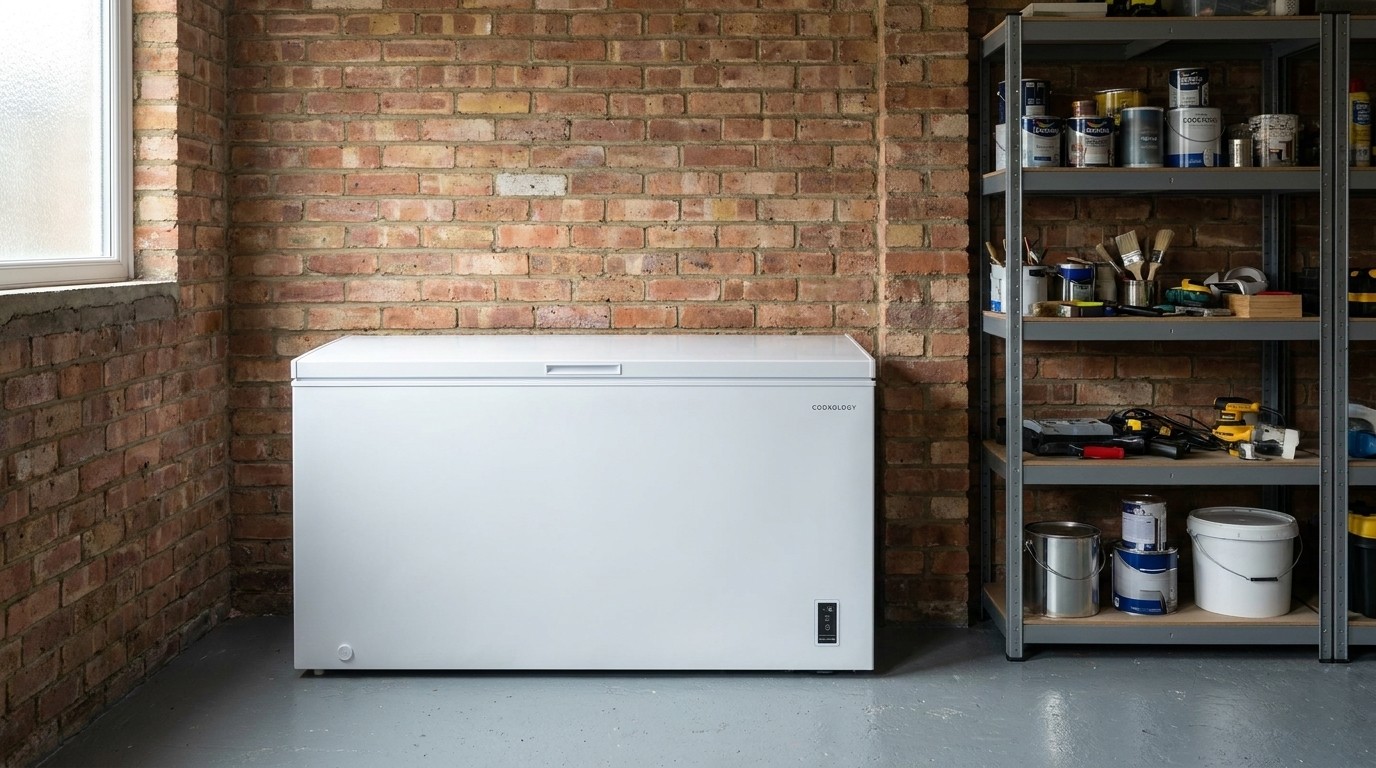
A chest freezer is a top-opening, freestanding freezer that holds food at -18°C or colder, ideal for batch cooks and bulk shoppers. Loading from the top traps cold air on every opening, so chest models run cheaper per litre than uprights and most are rated for unheated UK garages. Cookology’s chest freezer range runs from a 99-litre flat-sized model up to a 418-litre family chest.
What size chest freezer do I need?
Sizing is the first thing readers ring our customer service team about. As a rough guide, Cookology suggests allowing 60 litres of freezer space per adult plus 40 litres per child, then adding headroom for the way you actually shop. A couple ordering a meat box every quarter wants 200 litres or more. A family of four batch-cooking Sunday lunches needs 300-plus.
The Cookology line-up runs five sizes. Capacities, dimensions, energy figures and noise levels below are pulled directly from the current product database, but always check the live product page before ordering because specs do occasionally change.
| Model | Capacity | External W × D × H (mm) | Energy rating | Annual energy use | Noise | Controls |
|---|---|---|---|---|---|---|
| 99L Chest Freezer, White or Black | 99 L | 547 × 446 × 850 | E | 169 kWh | 38 dB | Dial |
| 142L Chest Freezer, White or Black | 142 L | 600 × 560 × 850 | E | 182 kWh | 40 dB | Dial |
| 198L Chest Freezer, White or Black | 198 L | 770 × 560 × 850 | E | 200 kWh | 41 dB | Dial |
| 293L Chest Freezer, White or Black | 293 L | 1065 × 592 × 844 | E | 230 kWh | 41 dB | Dial |
| 418L Chest Freezer, White or Black | 418 L | 1416 × 750 × 825 | E | 269 kWh | 44 dB | Touch |
Looking at those dimensions in real terms:
- The 99L is the only model narrow enough for a 600 mm utility-cupboard gap with room to swing the lid clear, useful in flats and small terraces.
- The 142L and 198L share an 850 mm height and a 560 mm depth, so a shelf or worktop running across them stays level if you upgrade later.
- Cookology lists the 418L as the only chest in this range with touch controls, which matters when the lid is 1.4 metres long and you’d rather not stoop to find the dial.
- According to Cookology’s specifications, every size is rated SN to ST as a minimum, and the 293L and 418L extend to T, which is why all five are flagged as suitable for outbuildings.
Worked out roughly what you need? You can sort the full Cookology chest freezer collection by size and pick on dimensions in two clicks.
What actually fits inside a chest freezer?
Litres are abstract until you translate them into shopping. Use these as rough working figures from the way our own customers describe loading the things, not lab measurements:
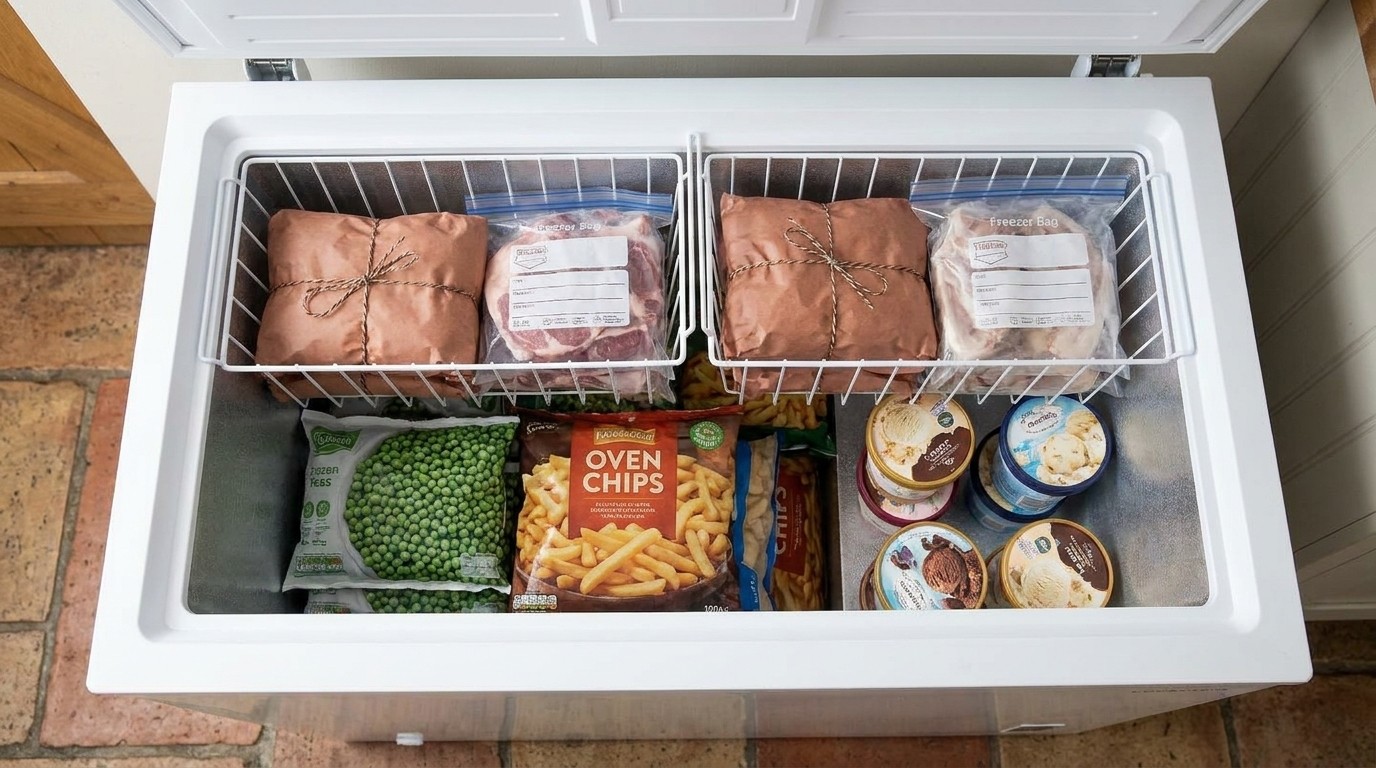
- 99 litres, about one big meat box, or a fortnight’s worth of frozen veg, oven chips, ice cream and a few ready meals for one or two people. Treat it as a top-up freezer next to a fridge-freezer.
- 142 litres, a small family’s weekly frozen shop plus batch-cooked portions for the week. Roughly the footprint of a washing machine on the floor.
- 198 litres, a monthly bulk shop for two adults with room for a turkey at Christmas. Sits comfortably in most utility rooms.
- 293 litres, a four-person household running a quarterly meat box plus batch-cooked stews, soups and curries. Two baskets up top, deep well underneath.
- 418 litres, serious bulk territory. Allotment gluts, half a lamb, a Costco run and the Christmas turkey, all in one chest. Best in a garage or outbuilding rather than the kitchen.
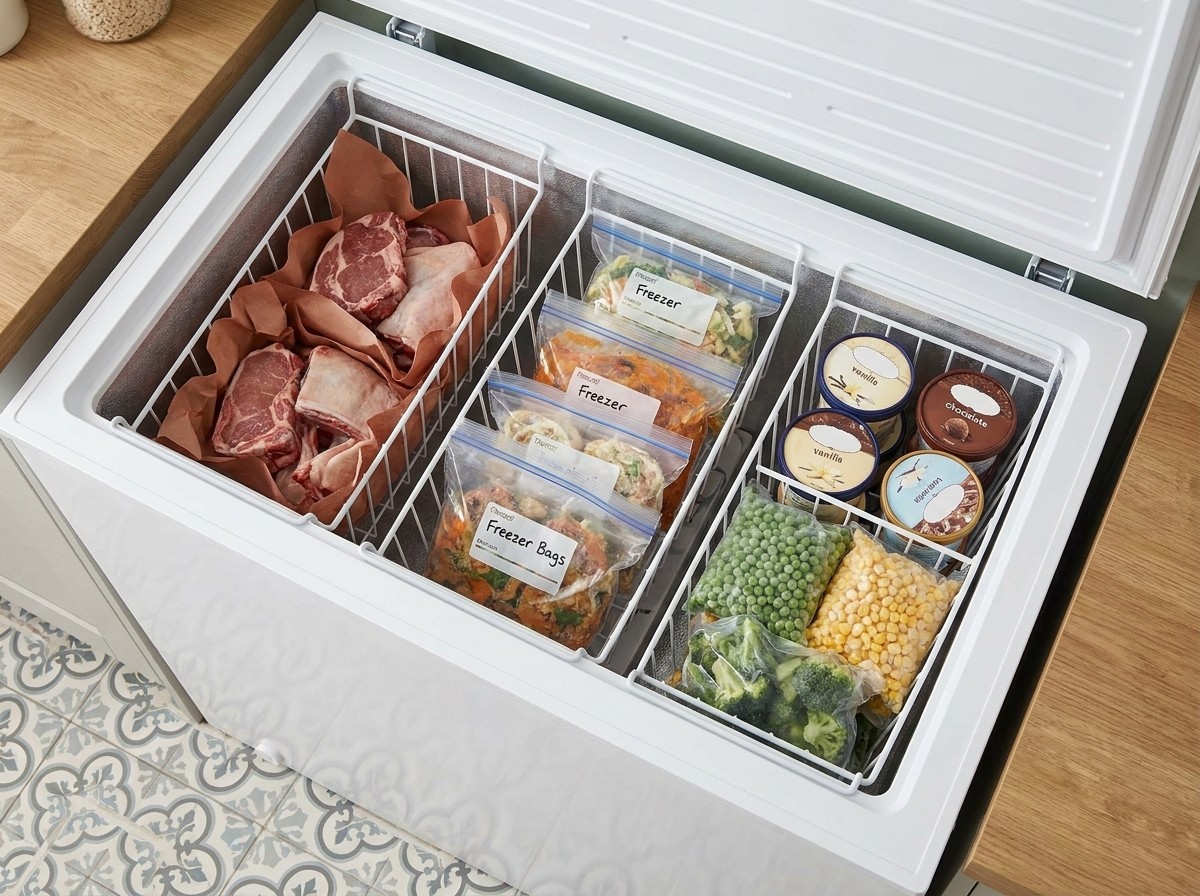
To stop your freezer turning into a black hole where frozen peas go to die, you need to use baskets. Cookology chest freezers come with removable wire hanging baskets that sit on the upper lip of the cabinet. These are perfect for keeping everyday items, like ice lollies, opened bags of chips, and small tubs, within easy reach, leaving the deep well underneath for bulky joints of meat and batch-cooked Tupperware.
As a handy visual guide, a standard four-pint milk bottle takes about 2.3 litres of freezer space, and a frozen pizza takes around 1.8 litres. So a 99L freezer holds roughly 40 pizzas, packed flat, with nothing else in. Once you add baskets, bags and air gaps, you lose some usable space, so always plan for 70 to 80 per cent of the rated capacity in real use.
Can I keep a chest freezer in a garage or outbuilding?
Yes, in most British garages and outbuildings, provided the freezer’s climate class covers the temperature range of the room. Every chest in the Cookology range is rated SN to ST as a minimum, with the 293L and 418L extending to T, so all five sizes carry the “suitable for outbuildings” tick on the spec sheet.
For most homes, an unheated brick garage, a covered car port, a brick outhouse or a utility lean-to is fine year-round across most of the UK. A damp shed with a dirt floor is not. The freezer needs a properly earthed 13A socket, level standing, and a few centimetres of clearance behind and to the sides for venting.
If your garage genuinely drops below 10°C overnight in winter (single-skin breeze-block, no insulation, north-facing) it’s worth choosing one of the larger sizes whose climate class stretches further down. The 293L and 418L are the safest pick for a cold space.
A quick note on freezing UK winters. Climate class SN is rated down to 10°C. If your unheated garage regularly drops to freezing (0°C or below) in January, the ambient temperature is colder than the freezer’s thermostat expects. While chest freezers are heavily insulated and often survive cold snaps fine, running them in sub-zero temperatures is not officially covered by standard climate classes. If your outbuilding is little more than a draughty tin shed, you may need to monitor it during severe cold warnings.
What does climate class SN, N, ST and T mean?
The four climate classes on a freezer label tell you the ambient room temperature the appliance is built to cope with. Run a freezer in a room colder or warmer than its class and the thermostat assumptions stop holding, which is how food ends up part-thawed in an unheated garage.
| Climate class | Ambient temperature range | Suits |
|---|---|---|
| SN (subnormal) | 10°C to 32°C | Cool utility rooms, conservatories |
| N (normal) | 16°C to 32°C | Heated kitchens, indoor utility |
| ST (subtropical) | 16°C to 38°C | Warm conservatories, summer outbuildings |
| T (tropical) | 16°C to 43°C | Hottest UK rooms; covers more than you need indoors |
Cookology rates the 99L, 142L and 198L as SN to ST, and the 293L and 418L as SN to T. A multi-class rating like “SN/N/ST/T” means the freezer holds temperature across the whole span, top to bottom. That’s the spec that earns the outbuilding tick.
How much does a chest freezer cost to run?
Every chest in the Cookology range carries an E energy rating under the post-2021 European energy label. That label was rescaled in 2021, so an E today is closer to what older labels called A+. The annual consumption figures are the more useful number, because they translate straight into pounds.
As a rough guide, based on typical recent Ofgem price caps, the running costs work out roughly as follows. Your actual unit rate will be on your latest bill or fixed-tariff quote, so adjust accordingly:
- 99L (169 kWh per year): Cookology estimates roughly £41
- 142L (182 kWh per year): Cookology estimates roughly £45
- 198L (200 kWh per year): Cookology estimates roughly £49
- 293L (230 kWh per year): Cookology estimates roughly £56
- 418L (269 kWh per year): Cookology estimates roughly £66
There are two things to keep in mind. First, those numbers assume the freezer is reasonably full and lives inside its rated climate class. While a freezer in a cold garage uses less electricity to maintain its temperature, an empty chest loses cold air much faster than a full one when opened. Second, the budget end of the range starts at just 169 kWh a year, which is one of the strongest cases for picking up a Cookology chest as a second freezer, the running cost is genuinely modest.
Chill or freeze: do you need a dual-function model?
What is the Chill and Freeze Function?
It’s a dual-function setting fitted to the 293L and 418L Cookology chests. A single control on the front switches the same cabinet between freezer mode at -18°C and chiller mode at around 5°C, no rewiring, no second compressor, no fuss. That flexibility is what people actually pay the difference for: a Christmas overflow fridge in December, a drinks chiller for a party weekend, a place to hold an allotment glut crisp before processing, or a catering backup when the main fridge is full. Flip the switch back and it’s a deep freeze again by the next day.
The 293L and 418L Cookology chests both include a dual chill-and-freeze function. The compressor and thermostat can run the cabinet as a deep freezer at -18°C in its normal mode, or step the temperature up to roughly fridge range (around 5°C) when you flip it to chill. It’s the same cabinet doing two jobs at the press of a switch.
How our customers use the dual function:
- Christmas overflow, switch to chill in mid-December and you’ve got a second fridge for trifles, sausage rolls and a turkey too big for the main fridge. Switch back to freeze in January.
- Parties and big batch cooks, keep cases of beer, prepped salads or marinating meat at fridge temperature for a weekend, then return to freezer service.
- Allotment and hobby growers, chill mode keeps a glut of veg crisp for a few days before you process and freeze it.
- Drinks-only second appliance, some customers run their chest in chill mode permanently as a garage drinks fridge.
The dual function is the standout feature in the Cookology chest freezer with chill and freeze function and the reason it picks up most of the five-star Trustpilot reviews on this category. The fixed-temperature 99L, 142L and 198L are deliberately simpler appliances, which is also why they sit at the budget end of the range.
How loud is a chest freezer?
Cookology lists noise ratings in the range from 38 dB on the 99L up to 44 dB on the 418L. For comparison, a quiet library reads around 30 dB and a normal conversation about 60 dB. The Cookology chest freezers all sit in the fridge-hum bracket. They’re audible if you stand next to them in a silent room, and inaudible from the next room with a door shut.
If the freezer is going in a kitchen-diner you eat in, the smaller models at 38 to 41 dB are easier to live with. For a garage or utility room any of the five is fine. The 418L at 44 dB is the loudest in absolute terms but still well below conversational volume, so most people in a utility room never notice.
Where’s the best place to put a freestanding chest freezer?
Garages, utility rooms and outhouses are the standard homes for a chest freezer. The size of the lid means kitchens are usually a poor fit, you need clear ceiling space above to swing it fully open, and a 1.4-metre-long box eats wall length quickly. A few practical rules:
- Leave at least 50 mm of clearance behind and either side for ventilation. The compressor needs to dump heat somewhere.
- Stand it on a level, solid floor. Carpeted floors trap heat under the chassis and can shorten compressor life.
- Site it within a metre of an earthed 13A socket. Cookology chest freezers ship with a moulded plug included.
- Avoid full direct sunlight through a window, which forces the compressor to work harder.
Delivery and installation checklist before you order
Cookology delivers the chest freezer range free, fast, to UK mainland addresses, but the appliance is heavy and bulky, so the prep is on you. Run through this before you click buy:
- Measure the access route. The 418L is 1416 mm wide and 750 mm deep, so check doorways, hallway turns and any tight kitchen doors. The 99L at 547 mm is the only size that fits a standard internal door without manoeuvring.
- Measure the final spot. Add 50 mm side clearance and roughly 600 mm of lid-swing height above the cabinet.
- Check the socket. A standard earthed 13A socket within a metre, not on an extension lead. Garage sockets should be RCD-protected.
- Confirm the floor is level. A spirit level across the chest will save you a lot of compressor noise later.
- Leave it to settle. Stand the freezer upright for at least four hours after delivery before plugging in, longer if it’s travelled on its side. The compressor oil needs to settle back where it belongs.
- Load gradually. Switch on and let it reach temperature empty for a few hours, then load in stages over a day rather than all at once.
A second pair of hands helps. The 418L weighs 53 kg and the 293L 32.5 kg, both two-person lifts. The 99L at 22 kg is light enough to shuffle solo on a furniture slider.
How easy is it to defrost a Cookology chest freezer?
Like most chest freezers on the market, the Cookology range requires manual defrosting to keep it running efficiently. Ice build-up acts as an insulator, forcing the compressor to work harder and increasing your energy bills. Thankfully, you do not need to go at it with a hairdryer. Every Cookology chest freezer features a front-facing drainage port. When it is time to defrost (usually once or twice a year), simply unplug the unit, place a shallow tray under the port, and let the ice melt naturally. Wipe the interior dry before switching it back on.
Frequently asked questions
-
How long does a chest freezer keep food frozen during a power cut?
A full chest freezer typically holds safe freezing temperatures for 24 to 48 hours with the lid kept shut, longer than an upright because cold air sinks and stays in the box. Don’t open the lid to check, every opening wastes hours of hold time.
-
What's the warranty on a Cookology chest freezer?
Cookology chest freezers come with a standard 12-month manufacturer warranty covering parts and labour for faults out of the box. Warranty queries go directly through Cookology’s UK customer service team, not a third-party retailer, so you’re speaking to people who know the appliance.
-
Do I need to defrost a chest freezer?
Yes, Cookology chest freezers are manual-defrost models, which is part of why the running costs are low. Plan to defrost once or twice a year, or when the ice build-up on the walls exceeds about 5 mm. There’s a drain plug in the base to make the meltwater easier to handle.
-
Can I lay a chest freezer on its side for transport?
You can, briefly, but stand it upright for at least four hours before plugging in, and longer (overnight is safest) if it’s spent any real time on its side. The compressor oil needs to drain back before the motor runs.
-
How does a chest freezer compare to an upright for the same money?
At the same price point a chest gives you more usable litres, lower running costs and longer hold time during a power cut. An upright gives you shelves you can see at a glance and a smaller floor footprint. Chests win for batch cookers and bulk shoppers, uprights win for daily frozen-meal households.
What to do next
Worked out the size that fits your household and your room? Shop the full Cookology chest freezer range and filter by capacity, colour and dimensions. You get free fast UK delivery, support from our own UK customer service team if you’ve got a question, and 19,000+ Trustpilot reviews at 4.5 to back it up.
Related from Cookology
- Shop our best-selling chest freezers, the full range, sortable by size
- 418L Chest Freezer with Chill and Freeze Function in White, our largest dual-function chest for serious bulk storage
- Cookology Chest Freezer with Chill and Freeze Function, the dual-mode pick our customer service team most often recommends